CrownRing Engineering Reference
CrownRing is a patent-pending, noncircular bicycle chainring designed to vary effective gearing throughout the pedal revolution. Its purpose is to better match the mechanical demands of the drivetrain to the changing capabilities of the rider.
Unlike a conventional round chainring, CrownRing uses two opposed crowns to produce a controlled variation in effective radius. The geometry and rotational position of those crowns determine when the effective gearing increases and decreases.
CrownRing doesn't simply reinvent the oval chainring. In an important sense, it takes the opposite approach. Where a conventional oval increases the effective ratio near 90° of crank rotation, CrownRing maintains the lower ratio through that position and increases it later in the power stroke, matching the gearing more closely to the rider's increasing ability to apply force.
This reference describes the operating principles, design relationships, prototype observations, and questions requiring independent measurement.
Contents
- Operating Principle
- Chainring Geometry
- Pedal Stroke and Timing
- Effective Gearing
- Crown Configurations
- Chain Load and Mechanical Effects
- Rider Interaction
- Initial Riding Evaluation
- Prototype Testing
- Independent Validation
- Practical CrownRing Calculations
1. Operating Principle
A round chainring maintains a constant effective radius throughout its revolution. For a given rear sprocket, this produces a constant nominal transmission ratio.
CrownRing deliberately varies that relationship. Its effective radius increases during a selected portion of the pedal downstroke, reaches a maximum, and then decreases.

CrownRing in motion. The changing effective radius alters chain travel throughout the pedal revolution, providing lower gearing early in the downstroke and higher gearing later.
The intention is to introduce higher effective gearing later in the power stroke, where the rider's position allows greater applied force.
CrownRing does not generate additional energy or increase the rider's muscular strength. Instead, it redistributes the mechanical demands of the pedal stroke.
2. Chainring Geometry
CrownRing uses two opposed crowns arranged around the chainring circumference. The resulting profile is elongated rather than circular.
The two-crown arrangement provides a repeating gearing pattern, with one crown acting during each successive pedal downstroke.
Three principal dimensions are important:
- Low: The minimum effective tooth-count equivalent.
- High: The maximum effective tooth-count equivalent.
- Draw: The chain travel equivalent used in CrownRing's practical gearing calculations.
These quantities describe different properties. In particular, tooth draw is not necessarily equivalent to the maximum effective gearing.
The detailed relationship between the chainring profile, chain engagement, and instantaneous transmission ratio is a subject for geometric analysis and direct measurement.
3. Pedal Stroke and Timing
For CrownRing analysis, a stroke is defined as one 180-degree pedal downstroke, rather than a complete 360-degree crank revolution.
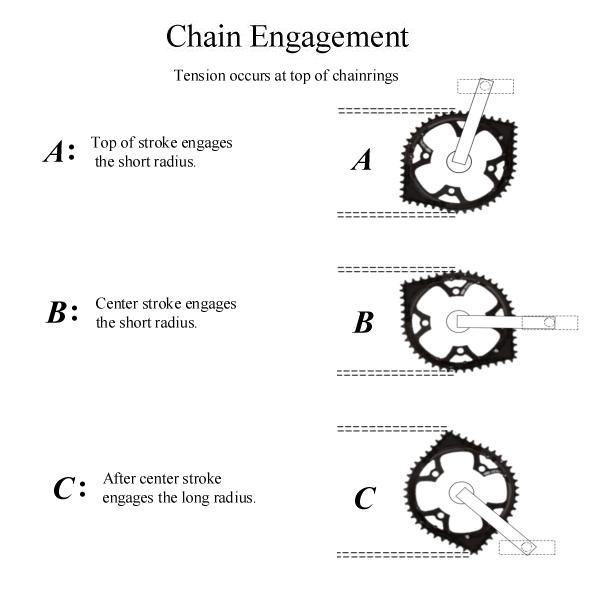
Chain engagement during the downstroke. The shorter radius remains engaged through the first 90 degrees, followed by the increasing radius during the stronger portion of the stroke.
The intended effective gearing progression is:
- 0° to 90°: Low effective gearing.
- 90° to approximately 135°: Increasing effective gearing.
- Approximately 135°: Maximum effective gearing.
- 135° to 180°: Declining effective gearing toward the low region.
The approximately 135-degree maximum is an intentional design target, not an independently established universal maximum of human pedal force.
The rotational position of the chainring relative to the crank determines its timing. Chain geometry and rear sprocket selection can also affect the effective timing of chain engagement.
After reaching its maximum effective radius near 135 degrees, CrownRing progressively reduces its gearing toward the bottom of the downstroke.
As the crank approaches 180 degrees, the pedal's mechanical advantage declines. CrownRing's decreasing radius follows this decline, reducing the gearing demand as the crank approaches the bottom of its rotation.
The crown's rise and decline are therefore both important. The increasing radius makes use of the rider's greater available strength, while the decreasing radius accommodates the declining mechanical advantage near the end of the stroke.
The timing along with the deliberately limited flat incline and decline positions the crown's entire cycle within the last 90° of the downstoke.
4. Effective Gearing
For a conventional round chainring, the nominal transmission ratio is:
Ratio = Front teeth / Rear teeth
For CrownRing, the instantaneous effective ratio changes with chainring position.
A useful approximation is:
Effective ratio = Instantaneous effective front radius / Rear sprocket pitch radius
Because the effective front radius varies, the mechanical advantage also varies through the stroke.
For an idealized drivetrain, crank torque and chain tension are related approximately by:
Chain tension = Crank torque / Effective front radius
This relationship illustrates an important tradeoff: increasing the effective radius raises the chain travel per unit crank rotation but also increases the crank torque required for a given chain tension.
Whether this change benefits the rider depends on the torque the rider can produce at that point in the stroke. A moderate crown requires a smaller increase in torque, while a larger crown requires more. The rider's ability to manage either depends on the resistance encountered.
5. Crown Configurations
CrownRing has been developed with three principal crown sizes. Each produces a different range of effective gearing.

Comparison of a conventional round chainring with CrownRing configurations 1, 2, and 3. Each successive crown produces a greater variation in effective gearing.
| Configuration | Draw | High |
|---|---|---|
| Crown 1 | Low + 2 | Low + 6 |
| Crown 2 | Low + 4 | Low + 13 |
| Crown 3 | Low + 6 | Low + 18 |
These are CrownRing's established practical design relationships, expressed in tooth-count equivalents. They are not presented as universal equations for arbitrary noncircular chainrings.
CrownRing notation identifies the physical tooth count, effective gearing range, and crown size in that order.
Example denotations:
- 48T/44-57(2): A 48-tooth chainring with a low equivalent of 44T, a high equivalent of 57T, and Crown 2 geometry.
- 54T/52-58(1): A 54-tooth chainring with a low equivalent of 52T, a high equivalent of 58T, and Crown 1 geometry.
- 72T/66-84(3): A 72-tooth chainring with a low equivalent of 66T, a high equivalent of 84T, and Crown 3 geometry.
Crown size is determined by the number of tooth positions skipped when indexing the crown peak relative to the valley: one for Crown 1, two for Crown 2, and three for Crown 3.
The initial tooth count describes the chainring's physical tooth count. Unlike a conventional round chainring, this number alone does not determine CrownRing's instantaneous effective transmission ratio.
The configurations have different intended applications:
- Crown 1: A relatively modest gearing variation, intended for higher-cadence riding.
- Crown 2: A moderate variation, intended for general riding and mixed terrain.
- Crown 3: A larger variation, intended for riders who favor lower cadence and greater pedal force.
Selection is rider-dependent. The greatest gearing variation is not necessarily the most effective choice for a given rider.
6. Chain Load and Mechanical Effects
Noncircular gearing changes the relationship between crank rotation and chain movement. Consequently, chain speed and the torque required at the crank vary through the stroke.
These changes can influence:
- Instantaneous chain tension.
- Rear derailleur movement and chain management.
- Chain engagement and retention.
- Cadence uniformity under load.
- The rider's perception of resistance.
The actual behavior depends on chainring geometry, rear sprocket size, chain tension, drivetrain configuration, and rider input.
Prototype development has included adjustments to chainline and chain guidance to improve retention and reliability.
Quantifying the dynamic loads and comparing them with conventional drivetrains will require instrumented testing.
7. Rider Interaction
Human pedaling capability is not uniform throughout the crank revolution.
Joint geometry, muscle recruitment, pedal direction, cadence, and rider position all influence the torque available at a particular crank angle.
CrownRing is based on the premise that effective gearing can be increased during portions of the downstroke where the rider has greater torque-producing capability.
However, the optimal relationship is not necessarily identical for every rider.
A rider who pedals at high cadence may respond differently from one who favors slower, more forceful strokes. Seated and standing pedaling may also produce different results.
For this reason, CrownRing's crown size and timing are treated as fitting variables, rather than a single universal configuration.
8. Initial Riding Evaluation
The first CrownRing riding evaluation used a 54T / 48–66(3) configuration on a bicycle equipped with an 18T rear freewheel. Testing took place on flat roads and mild inclines of approximately 3.5%.
Compared with the bicycle's original 48T round chainring, the CrownRing produced a noticeably more natural pedaling experience. Despite the substantial variation in effective gearing, the crown transition was largely unnoticed.
The difference was sufficiently pronounced that a second, comparable bicycle was purchased to serve as a conventional-chainring control for further evaluation.
These initial results were subjective riding observations rather than instrumented measurements, but they established the direction for subsequent development.
9. Prototype Testing
CrownRing has been developed through repeated prototype construction, modification, and riding evaluation.

Early demonstration bicycles used for comparative riding evaluations. CrownRing versus a conventional round chainring.
Testing has included conventional round chainrings and CrownRing configurations on different bicycles and with different rear gearing arrangements.
Reported observations include:
- Differences in perceived pedal resistance between round and CrownRing configurations.
- Changes in the perceived effort required during the later portion of the downstroke.
- Differences in climbing behavior and preferred gearing.
- Rider-dependent preferences for crown size and cadence.
These observations have guided the development of CrownRing but should not be interpreted as controlled scientific measurements.
Factors such as rider adaptation, fatigue, cadence, terrain, and bicycle setup can influence comparisons.
10. Independent Validation
Several important questions remain suitable for independent investigation.
- How does instantaneous chain travel compare with the predicted geometry?
- How does crank torque vary through the stroke under controlled loading?
- How does CrownRing affect rider cadence, mechanical power, and efficiency?
- How do crown size and timing affect riders with different pedaling styles?
- How do drivetrain losses and chain dynamics compare with round chainrings?
- Can measured results reproduce the differences reported during prototype riding?
A controlled comparison should account for average gearing, crank length, bicycle setup, cadence, rider power, and environmental conditions.
The goal of independent testing is not merely to confirm an expected result, but to establish where CrownRing offers measurable advantages, where it does not, and which configurations best suit particular riders.
Practical CrownRing Calculations
CrownRing dimensions follow a set of design relationships based on the total tooth count and the selected crown size.
For these calculations:
- D = Draw, the total number of teeth around the chainring perimeter.
- C = Crown size, expressed as a positive whole number.
- L = Low effective tooth-count equivalent.
- H = High effective tooth-count equivalent.
Low Effective Gearing
L = D − 2C
High Effective Gearing
H = D + 4C + 1 + (−1)C 2
The final term accounts for the difference between even and odd crown sizes. It equals zero for odd crowns and one for even crowns.
Example: 46T(2)
A CrownRing with 46 teeth and a Crown 2 configuration has:
L = 46 − (2 × 2) = 42
H = 46 + (4 × 2) + 1 = 55
Its complete designation is therefore 46T/42–55(2).
The abbreviated designation 46T(2) contains enough information to calculate both the low and high values.
Further Development
CrownRing is a working invention undergoing continued refinement. Engineering evaluation, instrumentation, manufacturing expertise, and independent rider testing are welcome.
For inquiries, please visit the Contact page.