
Navigation
Crownring
Crown vs Oval
Q & A
Efficiency
Environment
Demo Bikes
Manufacture
Speed Bump
Timing
Stretch
Gemini AI
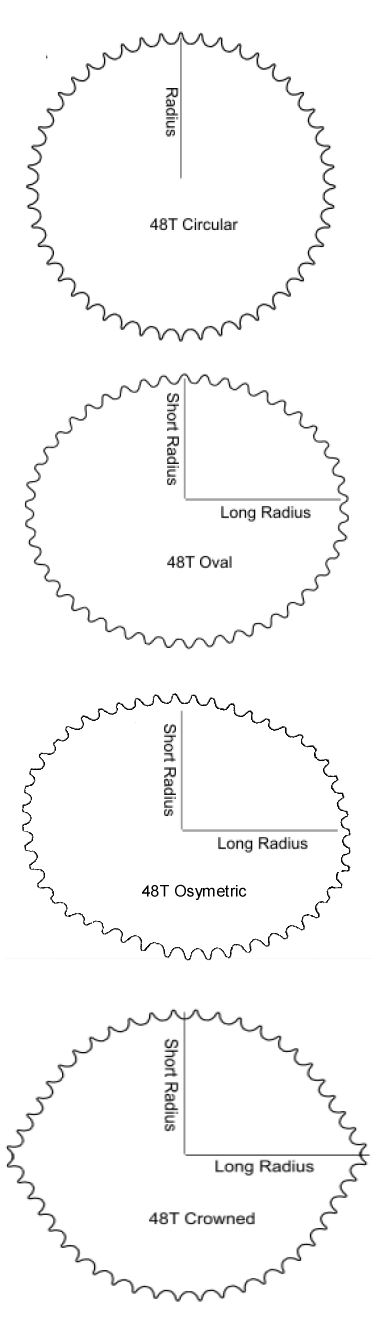
The round ring has a fixed radius. Leverage acts on this with a symmetrical ratio of high, low, high. The highs average a ratio of 1:1. Low is 2:1. Center stroke is twice as easy as top and bottom stroke. Center is your power. Top and bottom is your speed.
The oval ring has a profile of dual radii. Leverage acts on it with a linear high, high, high. The entire stroke is a 1:1 ratio. Its claim is continuous force input is more efficient, resulting in a power output for the entire stroke. What is not mentioned is the constant Time Under Tension (TUT) is exhausting. Nor does it provide a power zone. Hills are laborious. Ovals are great for short, flat sprints, but they'll deplete endurance on lengthy runs.
The osymetric ring is similar to the oval as it raises radius for the greater length of the stroke, has the same radius top and bottom, and limits the power for uphill climbs. What is different is the osymetric chainring has a longer duration of high radius, and a more aggressive interchange between high and low radii.
Before revealing the dynamics of the crowned chainring lets look at the biomechanics of a pedal stroke. Everyone has experienced standing from a too low chair. It is difficult at first but after getting half way up it gets easier. The straight leg is stronger than the bent leg.
The round ring makes no concessions for the difference in leg posture. Its constant radius demands as much from the bent leg as it does from the straight leg. Although the ratio is the same, the top of the stroke is much harder than the bottom of the stroke. It siphons a rider's energy at the top, but fails to cultivate the greater strength at the bottom.
The oval ring also demands as much from the bent leg as it does the straight leg. As the rotation progresses the radius increases to maintain the continuation of the 1:1 ratio in contrast to the increased leverage. As rotation continues the ratio remains at 1:1. The leg posture has provided more strength, but the ratio fails to cultivate it.
Neither the round chainring nor the oval makes any use of the straight leg strength. A rider pedals along struggling through the first half stroke then limps through the second half stroke very easily but without relative power output.
In addition to taking the power of the center stroke out of the race, when each are limited to a 48T chain draw, the oval profile lowers radius of the top and bottom of the stroke as compared to the round ring. It reduces the ratio at the point of greatest strength limiting the speed a rider can accomplish.
The Crownring is different from both. At 48T it has a lower radius throughout the first half of the stroke providing an easier start, much like the oval does. But Crownring holds on to the lower radius through the center of the stroke thus not only keeping the power zone intact but its center stroke radius is lower than the round chainring's center stroke radius, and very much lower than the oval's. Center stroke with Crownring is more powerful than either of the others.
What happens next is the incline to the peak. Crownring raises the radius in the second half of the stroke thus making use of the rise in straight leg strength. This increase in ratio adds speed to the travel which increases kinetic energy which reduces the resistance that would be incurred on the other chainrings.
Two points about the pointy peak of the Crownring: the peak is active in a bell curve over the entire second half of the stroke. While it might look like a pointy sharp strain on the stroke, it has a natural feel that balances with the rise in leg strength over the course of its engagement.
But most important, where the round ring and the oval ring end their strokes with infinite ratio rise, the Crownring's declining radius matches the decline in leverage, resulting in a smooth, longer application of the ratio derived at peak. It is those odd, flat, straight, ramps that gives Crownring its superb efficiency.
If you want to look at it as effort, the round ring and the oval ring get harder to apply force in the last degrees of their strokes until it results in the dreaded Dead Zone. Crownring maintains the peak ratio through the last degrees of the stroke. It does not get infinitely harder.
Crownring provides an easier start, more uphill power, a boost of speed when strength, leverage, and pedal trajectory are optimal, and it holds that speed deep into the dead zone.
Because of the bio-mechanical balance that Crownring provides on any stroke through any terrain Crownring is easier, and that translates to more endurance.
Don't take my word for it. Let's go for a ride.
Text updated January 12, 2025