
Navigation
Crownring
Crown vs Oval
Q & A
Efficiency
Environment
Demo Bikes
Manufacture
Speed Bump
Timing
Stretch
Gemini AI
The Mechanics of Crownring
Crownring is a patent pending, dual-radius chainring that dynamically adapts to the rider's pedaling motion. This biomechanical synchronization results in a more efficient transfer of power, reducing the metabolic cost of pedaling and increasing endurance.
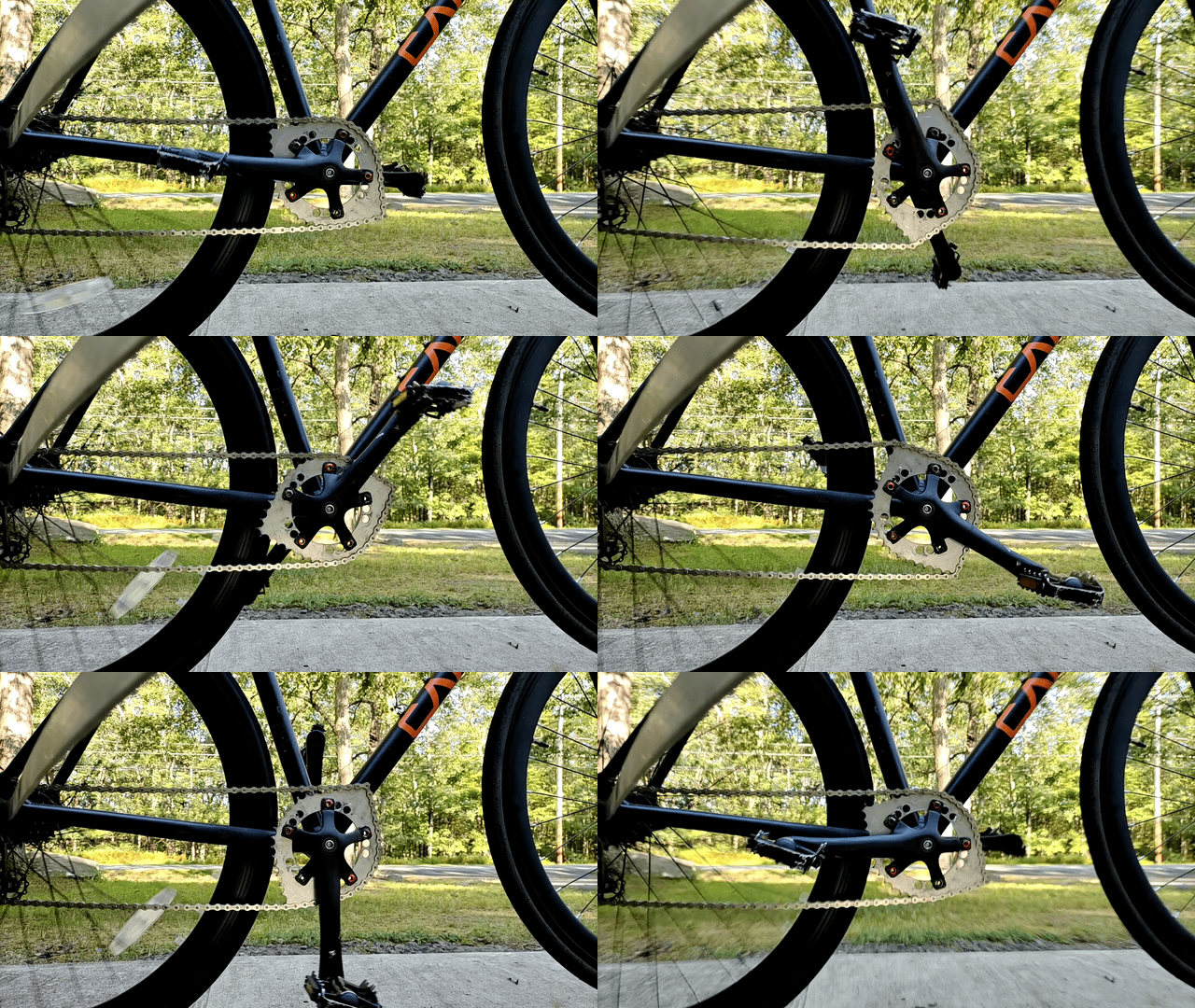
What you see in the looping animation is a crowned-chainring with a draw of 40 teeth. What is hard to see is, while the Crownring is technically 40T, because of its dual nature the draw through the first half of the stroke is 36T, and the draw through the second half of the stroke increases to 49T. It operates with 36-49 combo draw. Notice the top and bottom sections of chain and the gap between them. As the Crownring enters the 49T phase through the second half of the stroke the chain's gap widens indicating the larger diameter.
The Physics
The reason Crownring works is the same as a deep knee bend. Anyone familiar with squats knows standing from a crouched position is easier once you pass the halfway mark. Similarly, during the pedal stroke, the rider's leg is stronger when it reaches the straight leg posture. By increasing the chainring's diameter at exactly this moment, the Crownring taps into this reservoir of strength, converting it to increased speed.
Because the Crownring's ratio is lower through the first half of the stroke the stress is reduced. This prolongs endurance and helps to tame hills. Then, as the leg straightens, the ratio increases using your strength seamlessly. I say seamless because your strength increase is greater than the ratio increase thus your stroke is smooth and natural. The change is completely unnoticeable.
A final, powerful aspect of the Crownring is how its high crown radius becomes dominant. While it seems counter-intuitive, a 40T Crownring, as shown in our animation, delivers the same speed, stroke for stroke, as a 48T round chainring. How can a 40T effectively equal a 48T in performance? The answer lies in Inertial Stretch and the creation of a Virtual Gear.
Just as every bicycle "drifts" through its dead zones, the Crownring uniquely leverages this drift and the bicycle's existing momentum. By accelerating the bicycle efficiently through the high radius of the crown, the kinetic energy already present in the bike effectively "stretches" the standard 40T chain draw into the greater travel equivalent of a 48T. This allows the bicycle to coast faster through pedal-ineffective zones, harnessing inertia more efficiently than a traditional round chainring.
The Math
Crown Size:
Now that you have been introduced to the physics of Crownring, lets get into the math. The Crownring in the animation has a 40T draw. A 36T low radius, and a 49T high radius. I depict this as 40T/36-49(2). The (2) is the crown size.
The crown can be a 1, 2, or 3. More than 3 and the pedaling can develop outpace wherein the top radius is so much smaller than the bottom radius that the foot can't keep up and has the potential to float off of the pedal. To determine the size of the crown a standard chainring is wrapped with the chain. Move one, two, or three links to pucker the chain.
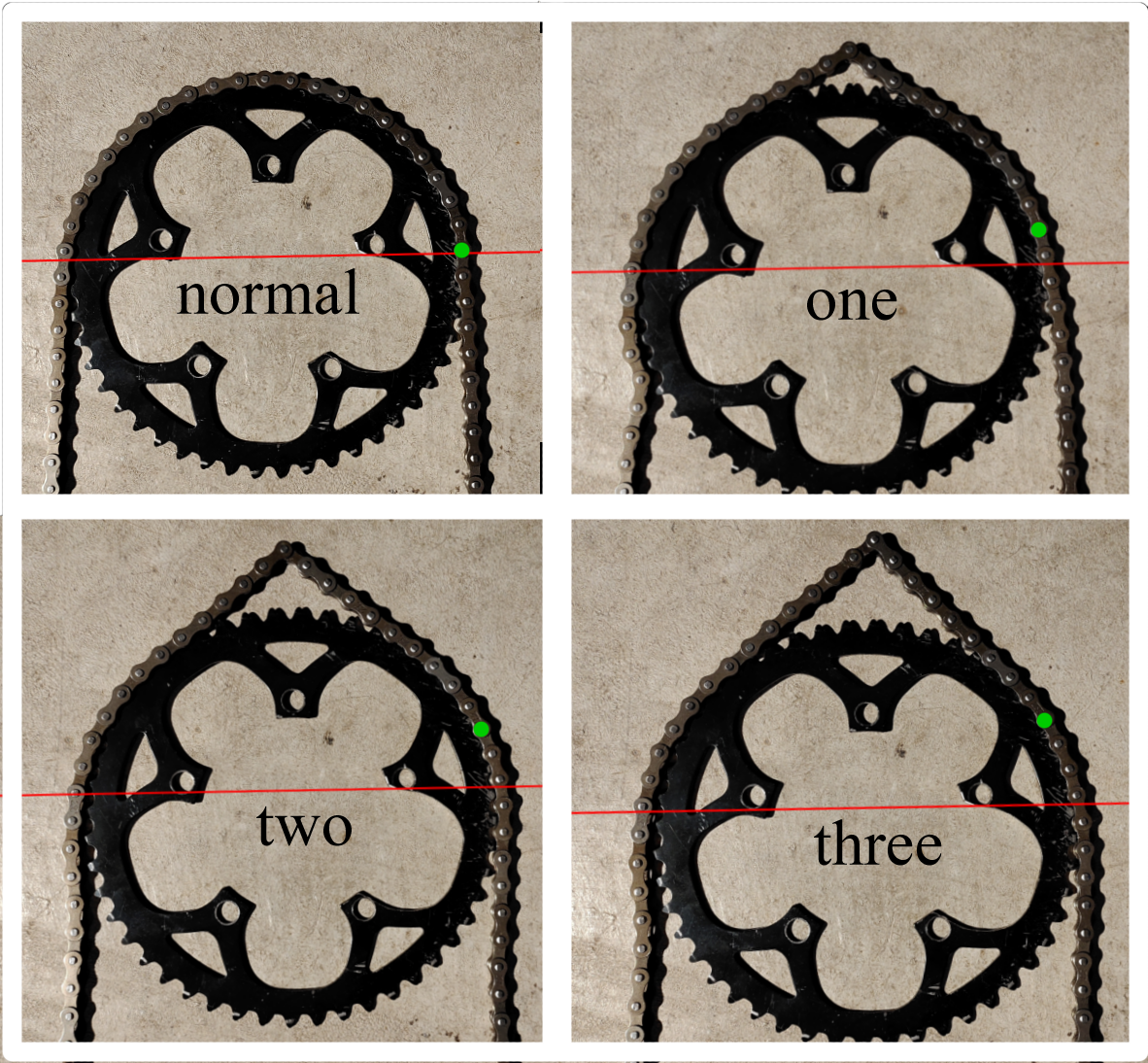
Given identical T-values the bigger the crown the smaller the small radius. If the 40T had a 3 size crown it would be 40T/34-52(3). Even though the draw is the same as with the 40T/36-49(2) the performances are completely different. The 3 size Crownring is faster than the same draw on a 2 size Crownring.
The (3) and the (1) have their places, but for just casual riding the (2) performs best.
Draw:
The 40T/36-49(2) Crownring is a great all-around power component. Its speed is the same as the 48T chainring, but it requires much less effort. Draw is an important value in the component because it relates directly to the crown size. In the 40T/36-49(2) there is a ratio difference of ~27% between 36T and 49T. If we look at a 24T/20-33(2) there is a ratio difference of ~40% between 20T and 33T. Even though they both have a (2) size crown the ending effort is greater with the smaller Crownring. 40% is about the rule of thumb for strength increase. If the ratio difference exceeds strength difference then the Crownring ceases to feel like an advantage. Smaller Crownrings work best with smaller crowns. A 24T/22-28(1) still provides crown advantage but does not peak the strength index with its ~22%.
The percentages are derived through decomposition. With 24T/22-28(1) we use 100/28=3.57. 3.57*22=78.54. 100-78.54=21.46. This gives us a radius variation between ~21 and 22%.
By dropping the crown size we bring the radius index down to less than the strength index making for a comfortable stress-free stroke. The crown still provides the range of a 3 gear shift of a clustered freewheel (stepping 2, e.g. 20, 18, 16), which is easier and faster than the round 24T with the same freewheel range…without needing to shift.
Given the same logic, for those that like to use extreme chainrings, (66, 72, or greater), the (3) size crown would give them quite an edge. If they handle a 72T chainring then a 72T Crownring would be 72T/66-84(3). If we decompose the ratio we have 100/84=1.19. 1.19*66=78.54. 100-78.54=21.46% which is well within their strength index. Imagine cruising at 84T speed with 72T effort. Even less, because resistance (wind, hills) will meet the 66T radius being much easier than struggling against the same resistance with a 72T round chainring.
I don't make up the teeth counts. The draw is simply the count of teeth on the ring perimeter. The rest are dictated by crown size. There are formulas to arrive at the values.
Where D is draw, C is crown, L is low radius, H is high radius.
D - (2 x C) = L
or
L + (2 x C) = D
L + (6 x C) + (3 - C) = H
Given any two values these formulas will provide the other values. For that there is a shorthand for the Crownring designation. 46T/42-55(2) is also a nice cruising Crownring and can be fully depicted with 46T(2). The low and high can be identified by passing 46 draw and 2 crown through the formulas.
By replacing your chainring with the same T-value in Crownring you will pedal easier while traveling faster. For this the Crownring motto is "Easier, Faster." Alternatively, you can match your T-value with the low radius and go much faster without noticing other differences. It is Crownring's low radius that dictates ease of use, and its high radius that dictates speed. The draw and crown size merely manipulate the high and low.
If you are comfortable with your bicycle's ratio you should match the draw. If your bicycle is getting to be a challenge then match the high. If you want more speed then match the low.
Your 46T could become 46T/42-55(2) to be easier and faster, or 38T/34-47(2) to be much easier but retain speed, or 50T/46-59(2) for greater speed at minimum change in effort.
If it sounds too good to be true then give one a try. You won't need further convincing.
Text updated February 13, 2026