
Navigation
Crownring
Crown vs Oval
Q & A
Efficiency
Environment
Demo Bikes
Manufacture
Speed Bump
Timing
Stretch
Gemini AI
What is Stretch?
Crownring works by forcing a rise in the chainring radius. Initially, and quite functionally, the peak of the rise had only one link duration. Stretch is altering the peak duration for additional links. It does not add teeth to the perimeter. It merely stretches peak duration.
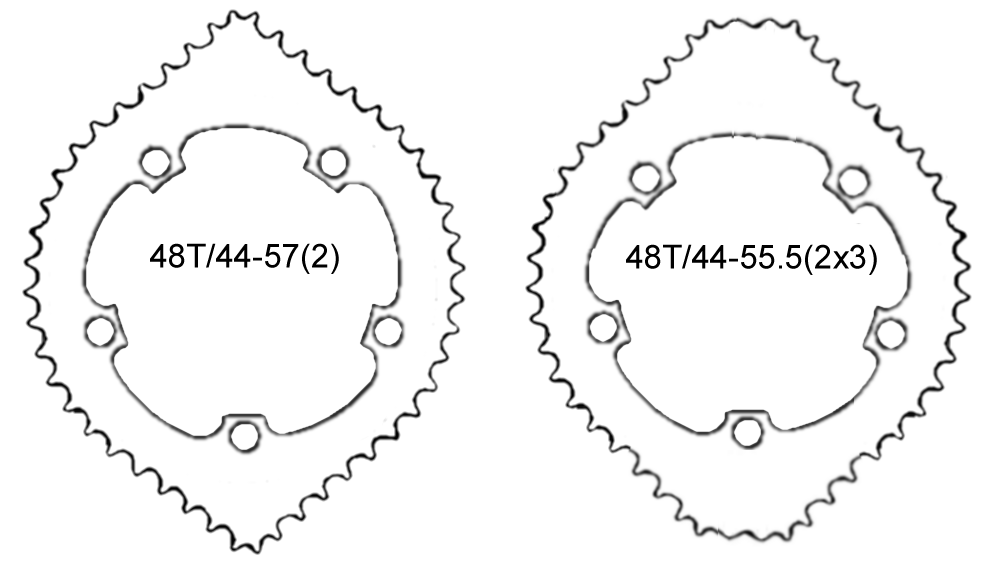
The numbers in parentheses tell of the crown size and the stretch. The other numbers are T-values— the number of teeth on the perimeter. They give experienced riders a comparison of ratio. 48T is a common chainring, thus the 48T in 48T/44-57(2) indicates the practical ratio of the Crownring. 48T chain draw is as a standard 48T chainring. Low radius compares to a 44T chainring. High radius compares to a 57T chainring.
So what is this 55.5T? You can't have half a tooth. True, but it is a virtual tooth count, not a literal one. The 55.5T is only meant to suggest that the radius falls between 55T and 56T equivalent.
Decline
One of the core properties of Crownring is its decline. The decline extends and maintains the highest ratio of the stroke. A round ring continues raising ratio into unusable levels. Decline allows a longer productive input of force. By stretching the peak we use up any leeway that the crown timing might have had. It is important to efficiency to retain as much decline as possible. Therefore there is a limit to stretch.
Ratio
The prototype stretched Crownring was a 32T modified with a size (2) crown altered by a 3 tooth stretch. I depict this as 36T(2x3). The 36T(2) standard Crownring has a high radius of 3.42 inches. By stretching the peak x3 it reduces the radius to 3.3 inches. The reduced radius lessens strain making the (2x3) stretched crown easier to power than the (2) crown. This is different than using a smaller crown. With stretch, the peak begins at about 115° and ends at 140° providing 25° of peak speed during the second half stroke. But more than that, the leverage decrease over those 25° will increase ratio making a (2x3) stretched crown faster than the standard (2) crown. Decline then caries that faster ratio into the Dead Zone and extends the usable force input.
I designed stretch to overcome the speed limitations of a standard crown. The standard crown decreases through the leverage decrease phase thus making for a very comfortable ending stroke, but it fails to utilize the inherent ratio increase of declining leverage. By stretching the peak duration it achieves ratio increase by holding the high radius farther into the declining leverage. Leverage decline is where professional bicyclists get their speed. They use their powerful ankles to force the pedal backwards and into the lowest leverage thereby increasing ratio. The deficit of a round chainring is it decreases leverage and raises ratio far more than any rider can manage— the Dead Zone.
Dead Zone
Stretch, the same as the standard Crownring, utilizes maximum strength with near maximum leverage giving the very highest power output. However stretch continues the peak into lesser leverage raising the ratio thus increasing speed. But more important than any of that, stretch delays the crown decline until the Dead Zone approaches. Crown decline does not increase ratio to unusable levels as a round ring does. Instead it carries the last usable ratio well into the Dead Zone make it a useful force input. The bottom Dead Zone is nearly eliminated giving pro racers an extended duration of speed.
Addendum
The red bike is equipped with a x2 stretched Crownring. That means 2 cradles at the peak. Below is my initial drawing of the Crownring for the red bike. The composited data was added for visual inclusion for this webpage. I can say that the second cradle is something you can definately feel.
.png)
The reason for the increase in effort is an increase in speed. When the #2 cradle is at peak the pedal leverage is at 5 inches. Those 10° of progression pushed the #1 cradle to 4 inches of leveraage. Cradle #1 is a 20% higher ratio than cradle #2. That higher ratio is the ratio that gets carried down the decline. With the effect of the bell curve the #1 peak is about 6.5% faster for the remainder of the stroke than the #2 peak.
Raising the ratio on the small 34T Crownring increased outpace but it's managable. You can feel it at the top of the stroke before you addapt your cadence to compensate. It's likely a leftover mucle memory from riding with round chainrings.
The 34T did not have arc duration enough to have the peak stretched to 3 cradles. However, a larger Crownring could accommodate the 3 cradle stretch, and that would raise the ratio even higher with only 3 inches of leverage.
Stretching the peak is definately a game changer, but its usefulness is speed only. You pay for it in increased effort. Not as much as getting the same from a round chainring. That would be impossible.
Text updated November 9, 2025