
Navigation
Crownring
Crown vs Oval
Q & A
Efficiency
Environment
Demo Bikes
Manufacture
Speed Bump
Timing
Stretch
Gemini AI

Building the Crownring Recumbent Tadpole Trike
March 26, 2026
Thursday, 2:00 PM
A great day to work outside. It is unfortunately a bad day for welding aluminum. I welded the boom's two pieces but it fell apart after aggressively testing it. I'm going to have to build the trike frame out of steel. That puts the project on hold until I can find donor bikes.
The uprights are still viable. All they needed was a Crownring sized for their performances. If I could find a recumbent to convert it would go a lot easier. The hold up is only the frame. The other features are still in play.
March 23, 2026
Monday, 9:30 AM
I mocked up the seat out of cardboard. I needed visualization to place the cross member.
The weather is improving. The cross member and steering elements will need welding. That's outside stuff.
This trike is what my AI calls a test-bed. There will be a lot of original concepts on it. I'll be able to improve or eliminate many for the build of the final trike. Keep in mind this trike is all junk parts. It's temporary. I'll make the next one out of new parts.
March 16, 2026
Monday, 10:00 PM
I've melted the frame together. Calling it welding is a stretch. Aluminum stick welding on the thin members of a bicycle frame is something of a challenge. But it is firmly reinforced for now. I can at least move on with more of the build. Next is the cross member. It is going to take some thought to cut it from my single stock material and have it correctly have caster and camber.
It's not the trike that needs to function perfectly. It is the drive train that is under scrutiny. The trike can be rebuilt.
February 18, 2026
Wednesday, 3:30 PM
I spent all day using Neo.ai as a sounding board for my ideas. It worked well. I now have a practical frame mod in mind. I'd struggled with this for months. Talking out each iteration with Neo guided me to a final concept much faster than I'd been able to do on my own. I can make a solid narrowed triangle frame out of my old mountain bike frame.
With the main frame a fixed idea I can move on to the cross member. Once the wheels are holding it up it is no longer a big sprawling project. It becomes several small isolated projects.
February 15, 2026
Sunday, 11:30 pm
The brake drums are on the wheels. I'm using go-cart strap brakes. I'll go into why when I explain the trike in total.
The cross member is still a fluid idea. It's configuration is to support the trike frame without full attachment. When building on the fly everything needs to be reversible. Live engineering around available scrap parts.
This is a seat-of-the-pants build. The only thing it has in common with a commercial trike is it has three wheels.
February 9, 2026
Monday 8:00 AM
I received the brake bands today. Mounting them on the wheel seems simple enough. Its holes don't match the spokes, but that's why they make drills.
The kingpins for the steering…well, the package was delivered empty. Replacements arriving this week.
The steering controls have changed. I saw no point in expansion steering or the 10-2 steering. Those are for an enclosed quad. I want to test them, but the trike is already overrun with new features.
The problem of material for the cross member is solved. It took some imagination but I worked out a form I can cut from aluminum I'd ordered for a project I later abandoned.
The weather's not warmed any. The shop is cold despite the heater.
January 18, 2026
Sunday, noon
Decisions, decisions, decisions. After reducing an old bike to a collection of spans I've got a general idea of how to construct the recumbent frame. If I were building from raw stock I could engineer the frame along with the trike's 10 custom features. It is incorporating these features that has made the frame a chore…and the fact that I am modifying an upright two wheeler to become a recumbent three wheeler.
The features?
- Custom derailleur; acts before the gears rather than under them.
- Ergonomic therapeutic seat; reduces spine pressure.
- Hip strap; provides full force without needing to press against the seat.
- Reverse; pedal backwards on the fixed cog
- Locking kickstand; raises the rear wheel from the ground—frees the wheel to shift while standing still, keeps the trike from rolling when parked, acts as a moderate theft prevention as the trike cannot be pedaled when it is engaged.
- Expansion steering; narrows the trike for bike lane compatibility without compromising stability.
- 10-2 steering control; mimics the action of an automotive steering wheel without needing a center post.
- Strap brakes; more stopping power with less
strain.
- Wide range 4 gear cluster.
- Crownring.
There are no failures, only learning.
January 8. 2026
5:00 PM
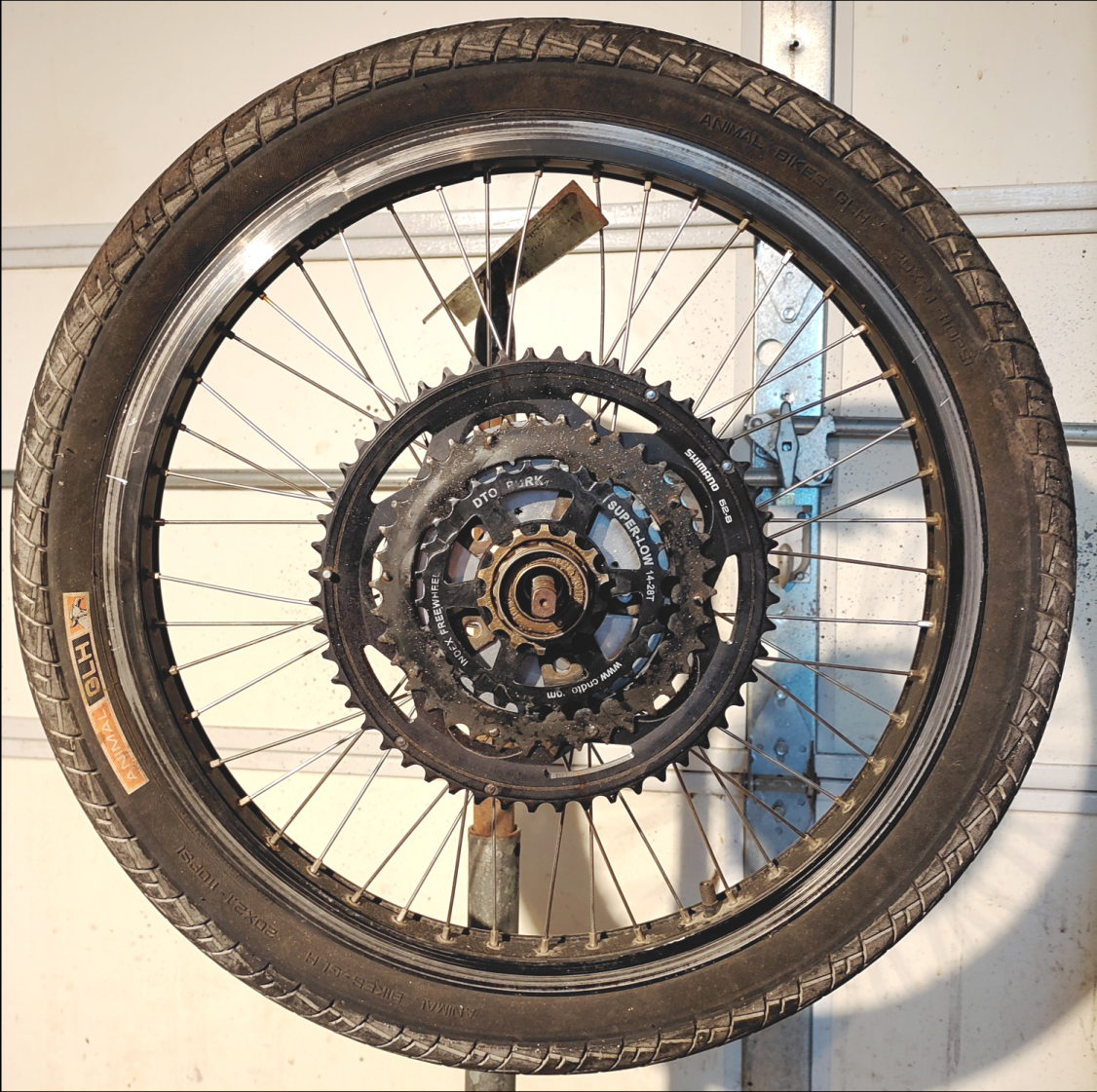
Twenty days ago I mocked up the recumbent rear wheel. 20", 4 gears; 14, 28, 38, 52, two freewheel gears for coasting, and two fixed gears for climbing. Nobody coasts uphill. The ratchet is superfluous. The thing about the fixed gears is they offer reverse when pedaled backwards. That was the inspiration for the design.
I have a tendency of seeing the end product without fully considering the in between steps. This wheel had a lot of them. I had to abandon a dozen approaches, often for not thinking three dimensionally. But at the end of it all, everything has worked out. The hub goes together as two pieces; adapter and freewheel. It will fit any wheel that accepts a common freewheel.
I was concerned about alignments. My shop is not equipped for precision work. And that contributed plenty to the do-over processes. It is assembled now and bench tests have indicated there should not be problems with field testing.
A prototype is only proof of concept. If this 4 gear spread works out then it will be adopted into the Crownring bicycle engineering. What I ended up with was a conglomeration of my disposable parts. If I were to engineer this wheel it would be done much differently.
December 28, 2025
3:30 PM
The adapter is rebuilt. I managed to get all cogs well centered. I need spacers to secure them on the hub, but that will conclude the wheel.
Next is the chainstay…rear frame assembly, and that will allow me to fabricate a custom derailleur for the 14-52T 4 gear cluster. The spar for the crankset will need to follow, which will let me test the entire drive.
For more than a decade I have been imagining how I want my trike. I will bring it all together soon enough and have my vision of a perfect recumbent trike…for my purposes.
December 20, 2025
1:30 PM
A drill press is a poor substitute for a milling machine.
I completed the adapter and mounted the 52T, then placed it on the wheel and spun it. It was out of round. Apparently my eyeballing skills aren't what they used to be, or the table arm slipped. Honestly, it might be both. Time for a do over. It's less effort to make a new one than to try to salvage the other.
To avoid the issue of the 52T needing meticulous placement I'll mount it first and determine absolute center from it. I'll place the 38T with regard to the 52T and all should fall into the proper place.
As long as you get there in the end.
December 18, 2025
Thursday, 10:00 AM
I'm taking a coffee break while working on the adapter for the rear gears. The rotating table helped but without being metered it's only so accurate.
The adapter is only a round plate with holes in it, but the holes really need to be in their right places. I've always been a "close enough" fabricator. Crownring has forced me to tighten my tolerances.
My philosophy is easy enough. If I break it I fix it. I never begrudge the experience of correcting a mistake.
I've gotten to fabricating the locking collar. What's a locking collar? When designing the gears to fit on the 12T freewheel, the big cog had to be put on the freewheel collar— the threaded part that holds the ratchet to the wheel. The 12T is compact so the gear is forward of the ratchet. Putting the 50T (at the time) behind the ratchet made the big gear (creeper gear) fixed. That took some consideration, but then I realized if you need that big cog to get up a hill you aren't going to coast anyway, so the freewheel is irreverent. A fixed low gear is fine.
Then it occurred to me. A fixed low gear could be used as a reverse. Just pedal backwards. The more I thought about it the more I liked.
To the point…I could have adapted the 52T to the freewheel, but fixing it to the wheel gives me that reverse gear. The adapter slips over the wheel threads and is held in place by the force of the mounted freewheel. That's all good except there is nothing to secure the big gear against the stress of an uphill climb, hence the locking collar. It will tab into the wheel and into the adapter to secure the 52T in place.
The reverse complicates the derailleur, but it's just another challenge to solve. Isn't that part of the human condition? A limiter on the range of the tensioner should fix the chain slack of the backwards rotation.
Once the adapter is in place, I'll fix the 38T to the adapter. It's low enough that having it fixed isn't going to cause an issue. There are a number of ways to have the 38T on the freewheel, but it would take some effort to carve it to fit the ridges, and a bit of welding. It's easier to bolt it to the adapter. If easy doesn't work then I can fix it later.
The 52T and the 38T are actually chainrings. The problem is they have cutouts that interfere with adapting them to a wheel. Putting square pegs in round holes is sort of my thing. There is a way to do anything. Getting there is half the fun.
I've known the wheel would be the hardest part of the build. I could use a 5 or 7 speed cassette and simplify it, but that wouldn't prove Crownrings 'virtual' Continually Variable Transmission (CVT) like capability. By gapping the gears so wide (14-28-38-52) it leaves the Crownring to make up the difference. I'll explain in detail how that works after the wheel is complete.
The coffee is gone. Time to get back to work.
3:30 PM
Things are working out. I assmbled the wheel as it will apear on the trike. If you can make out the 4 cogs, you'll see the big gap between tooth counts. I'm working on a theory here. It has yet to be validated. The Crownring's dual radii should balance out the extremes of the ranges. If it proves to be true, shifting could be 3 times faster.
December 12, 2025
Friday, 9:30 AM
It's been a thoughtful week. The rear wheel is the first phase to get built. The Crownring has certain abilities that the demo bikes don't point out, so the recumbent will have the first wheel built for the Crownring. I hope I'm right about it. That's the thing, failure leads to success.
I've been dragging out parts, bikes, wheels. My first expected wheel was a 20" with a coaster brake. Ordinarily that would work, but I have a feature for the trike that made that wheel impractical. I have an old heavy duty BMX that had a better wheel for the trike.
Why a 20"?
Overall vehicle length. There is no advantage to a bigger wheel unless you are hopping curbs and logs. Energy cares little about how you get to the travel. I don't accept this "chain-inches" jargon. It does not revel the energy involved. But Travel Per Stroke (TPS) says everything. One stroke, 2 feet, low gear. One stroke, 12 feet, high gear. The diameter of the wheel makes micro differences. You gear for travel.
So I found what really turned out to be the perfect wheel for the oddball gear cluster. I was planing the 12-23-50T but the 12T freewheel design made the attachment of the extra gears undesirable. So digging around in my chest of junk I found another hub from a 7 speed. It fit the 20" wheel threads. The smallest gear I can put on it is 14T. That changes the T value of the Crownriing.
Travels
A recumbent is half as efficient uphill as an upright. That has to be accounted for. A 26" 21 speed with 24T/24 low gear has a travel of 3.4 feet per stroke. Keeping the recumbent in that same effort range I'd need a travel of about 1.7 feet per stroke. The 14-50T would have been an acceptable gear cluster, but I don't have a 50T cog. I do have a 52T cog that I bought with the wrong BCD. Since the low gear needs an adapter plate I'll make one to fit the 130 BCD.
Rear wheel will be 14-52T. The 23T was to average between 12T and 50T. Now I have 14T and 52T. The hub came with a 28T. I am skeptical of the 28T leaping between itself and the 52T. I have a 38T handy that will ease the swap between 28T and 52T, but it is low enough to navigate gentle hills. The wheel will have a 14-28-38-52T cluster. Four speed. Faster shifting, so long as my expectation of needing fewer gears is correct.
When riding on flats kinetic energy fills the voids and the high radius is dominant. E.G. the black bike has a 40T/36-49(2) Crownring. On level road it goes as fast as a 49T chainring would. But uphill kinetic energy is lost much faster. The black bike goes uphill at its chain draw of 40T.
That is the magic of Crownring— it has a multi-ratio per stroke.
Uphill is my most concern. So what chain draw will give me 1.7 feet per stroke with a 52T at 20 inches?
Well, Crownring has another trick. Chain draw determines the travel uphill, but high radius keeps the speed up. Slowing down uphill can be fatal to the climb. Keeping the speed up is an advantage chainrings do not share. I learned the red bike can go uphill at twice the travel of the standard blue bike. The blue bike is a cheap bike. The red bike cost more than all my other bikes combined. Maybe quality helped. But if blue bike has 3 feet per stroke low, and recumbent is half efficient, and if Crownring can double uphill, I should be able to pull the hill at about the same ratio.
Hey! I have the original Crownring! 54T/48-66(3). 54/52x5.235 feet circumference comes to 2.7 feet per stroke. That is higher than optimal for a chainring but with Crownring it should do for starters. That's the thing about custom parts. I can make something new to fix what I break. You have to start someplace.
The 14T high with the 54T/48-66 makes for 66/14 = 4.71 wheel revolutions. 4.71 revolutions x 5.235 feet circumference = 24.65 feet per crank revolution. Divide by 2 for feet per stroke and it's 12.33.
A 26" bike with 48/13 (my old mountain bike) has 12.5 feet per stroke.
54T(3) with 14-28-38-52T rear will give me ratios slightly less than a common mountain bike. If I need to change performance I'll do it later. For now it is more practical to use what is on hand than fabricate new components. It is all experimental anyway.
I'll let you know when the wheel is built. Then we'll move on to the frame.
December 3, 2025
Why Ride A Recumbent?
The deficit of a recumbent, regardless of wheel count, is its inability to climb efficiently. Everywhere else the recumbent surpasses upright performance.
As an upright bicycle goes up a hill the body weight drops through each downstroke. This virtually divides the grade by 2. Your body is not climbing as fast as the bicycle.
There is no drop on the downstroke for a recumbent. Your body climbs right along with the bike or trike. This effectively makes hill climbs twice as hard compared to an upright.
So why ride a recumbent? The low profile of the recumbent cuts wind resistance by half. As wind is 3 times when speed doubles, at full speed the recumbent is 1/3 the effort of the upright against the wind.
Note: In September of 2018, behind a pace car to split the wind, Denise Mueller-Korenek shattered the previous land-speed record with 183 mph for the fastest human on a bicycle on earth. (Fascinating 20 minute video)
Wind resistance takes most of your energy. The low profile of the recumbent can curtail 66% of wind resistance as compared to the full body impact of an upright bicycle.
Why ride a recumbent? Less effort.
Gears?
The thing about gears is it is not about gears. It is about travel. Force in, travel out.
Gears are largely preferential. 3x7, 1x11, it depends a lot on your terrain and your style. Crownring complicates choices dramatically. Not that that is a bad thing. Crownring requires fewer gears. Fewer changes. It also has a three phase stroke which has little effect on a level ride, but changes dynamics when climbing. When I design a bicycle with a Crownring it is the climb I am most intent on. A recumbent makes that doubly so.
A 21 speed mountain bike commonly has a low gear of 24T/28. If the bike is the most common 26" then wheel travel is about 6.8 feet per revolution. Travel is the most important part of your gearing. At 24T/28 @ 26" your travel per stroke is 2.91 feet.
To equal that effort a recumbent's stroke distance needs to be about 1.5 feet.
This is where Crownring dynamics come into play. The lowest ratio of the gears should provide 1.5 feet. As I am building with a 20" wheel, by a standard chainring that would be 24T/46. As we have our travel adjusted for a 20" wheel we can look into the Crownring values.
A Crownring with 24T draw would lower the low radius so we need low radius at 24T. As this is quite a low ratio and would limit the high end of the trike, we will need the greatest increase which is a 3 crown. To get the 24T with a three crown we'd need a 30T/24-42(3) Crownring.
My current expectation is 12T high gear with additional gears of unknown value. But as we expect a 46T low that leaves 12-46, but in three gears; 12-23-46.
Crownring(3) has an 18 tooth radii variance which reduces the need for in between gears. By jumping from the 24T/12 to the 42T/23 the ratio change is the same as going from a 42T/21 to a 42T/23; the industry standard of jumping 2 teeth.
A 48T/13 @ 26" has a stroke travel of 12.5'. This was my previous gearing on my upright that gave me a steady 15 mph. That is the target.
The 30T/24-42(3) Crownring with a 12T rear would give 9.16' per stroke, about 25% slower than my benchmark. I need a bigger Crownring.
A 44T/38-56(3) would give 12.22' per stroke on a 12T rear. Close enough.
But that raised my low gear. A 46T rear stroke travel becomes 3.18'. I can bring that down with a bigger cog. A 50T would be a stroke distance of 1.99'. I can live with that.
As there is no commercially available 12-23-50T freewheel I'll have to fabricate one.
Crownring's low radius is benefited by its high radius. Prior test runs indicate that Crownring can double the gear and make the climb successfully. By retaining its speed up the hill with the high radius it contributes kinetic energy to the low radius. More kinetic energy means less resistance.
Otherwise, with the faster cadence of a lower gear, there is more stress from Time Under Tension by taking longer to pedal up the hill.
Crownrings capacity to increase kinetic energy causes a higher gearing to be more efficient. It's easier to go faster. This does not work with a chainring because a chainring demands more effort from the first half of the stroke than it does from the second half.
I am thinking the recumbent drive will benefit with a 44T/38-56(3) and a 12-50T rear. It still won't match the ease of a standard upright bicycle, but it should be close. The strength index is about 32% of my 40% strength increase. That should be fine.
I have collected used bicycles for this project. I love making something new from something old. This should be fun.